Blog
- 15 April 2017 » Four Views -- Philosophy and Christianity
- 5 April 2017 » Vishal Mangalwadi -- The Book that Made Your World: How the Bible Created the Soul of Western Civilization
- 29 March 2017 » Selections from Scottish Philosophy (Thomas Reid, James Beattie, Dugald Steward)
- 6 March 2017 » Introduction to Indian Philosophy -- Satischandra Chatterjee
- 26 Feb 2017 » History of Philosophy -- Roger Scruton
- 7 Feb 2017 » Von Humboldt
- 12 Jan 2017 Hi all this is my first blog post
Gottfried's books


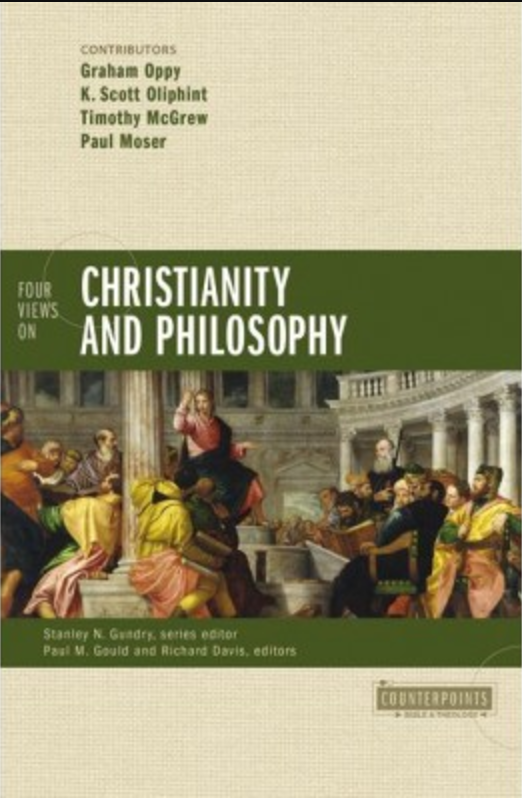
Four views talk about different views of Christianity and Philosophy together. Graham Oppy is probably the
best Philosopher alive, who has made good critiques of Christianity. In this book, each of the four give a model
for Philosophy and Christianity.
a) Conflict Model - Graham Oppy
b) Covenant Model - Scott Oliphint
c) Convergence Model - Timothy McGrew
d) Conformation Model - Paul Moser
Oppy's critique goes on something like this, Naturalism is more lean than Christianity, it has less ontological committments,
and explains the world. To add something more, would require more explanation. Thus Naturalism is best to explain the world.

Vishal Mangalwadi makes a big claim, that the Bible created the Soul of Western Civilization. It definitely has influenced so much of the Western Civilization, no doubt. There are many great things about the Western Civilization,and I feel that he did not build a solid case to argue for it. I do have the outside perspective for Western Civilization, yet I find his evidence lacking.
I found the blind assertions in his book irritating. He claimed something so broad without evidence and solid arguments. He would say, "X because of the Bible." That is circular, and vague. Eastern Christians (Orthodox) also had the Bible. Indeed, he could have argued that Bible was a vehicle that transmitted knowledge easily from West. We must be humble and learn from each other. Indeed there are somethings, that we can learn from Eastern Culture too.
I felt, he could have wrote his arguments and thoughts sharper and concise. He missed to answer, "How questions" in his book. A Giant leap and broad sweep of history. Overall, I do not think this is a solid book that proved his case. It's a hodge-pot mix of authors he learnt and read, and therefore his conclusion.

Scottish Common Sense contains selections from Thomas Reid, James Beattie, Dugald Steward.
Although, this was popular during Hume's time, not many thinkers revived it. You might not be aware of this. It influenced foundation of American thought. Most of the founding fathers read Scottish thought and it shaped their thinking. Conceps of Government, Law, Religion were shaped by Scottish, English, French writers.
Reid was writing this to counter scepticism of Hume. He found, the answer to Hume was Locke.
An outline of Reid's thought:
-Locke's system mainly contains mind, ideas and matter
-Berkeley's system contains mind, idea
-Hume contains idea
-Reid denies ideas, and considers only mind and matter.
"Kant did comment on Reid, but it seems that he did not read Reid, but only read review of Reid."
Reid goes on to talk about Knowledge, and examines it. He starts with external sense, analysis senses,
briefly writes on each of them, and concludes that we know, they exist through common sense.
Overall a good book to understand Scottish Common Sense.
Indian Philosophy seems to be concerned with, Karma , Self-Liberation , Brahman, Soul .
There are various schools of Indian thought -- Mimasa, Vedanta, Sankhya, Yoga, Nyaya, Vaisesika. The book defines, Karma as the law of conservation of moral values. Karma leads to bondage of soul by matter. It is the reason for suffering. So the question would be, How to liberate?
It didn't seem that a lot of things are happening in Indian philosophy, and most of the schools are reacting to each other.
Perhaps there are things happening within Indian Philosophy, And I might not be aware?Roger Scruton is an excellent writer. I came across his Green Philosophy -- Which argues for protecting the environment. However, he says -- we protect because our ancestors have left it to us.
In this book, he starts with Science, as the realm of empirical investigation. It stems from an attempt to understand the world, to predict and explain observable events, seeks to ask, "What causes that?"
This question intrigues me, Why should there be any events at all?
He says –– Philosophy ought to seek for truth, and abstractions. And then, he goes on to explain
various thinkers in Western tradition, starting from Descartes who changed the way, people began to
think. Spinoza's system was deterministic, and his theory of knowledge follows Plato. There's also
Leibniz, David Hume, Hobbes, Berkeley and others.
Political Science
Von Humboldt's book -- Limits of State Action is a classic in Liberalism.
He says, what end state institituons should be set to their activity is the main question of Political Science.
In other words, What is the limit of the State?
Other questions that come under it:
- Who shall be governed?
Who shall govern? Working of administration?
Sphere of Government
Somethings that went through my mind as I read his book were, his argument that, Freedom is pre-requisite for progress in society. His argument is that, without freedom, people are coerced into doing something they do not like. If it is so, then their heart would not be content, therefore they will not innovate. It does seem true.
He also emphasized a lot about focusing on Inner life, meaning focusing on Virtues. He cites the Greeksas examples, And it does seem true. Remember, he wrote this book around 1790's. The State's main function is
security from foreign powers, and internal crisis.
"Every Occupation of whatever nature is more efficiently performed,
if pursued for its own sake alone, rather for the results to which it leads" -- Von Humboldt
I recommend you reading this book.
This is my writing blog –– I love writing about various topics such as Poetry, Philosophy, Math, History.
Post content here, I do this and that.
Content and design by Rick Rejeleene Some rights reserved.
Powered by Github
Contact the webmaster.